Opinion: 'No one cares about Georgian government’s complaints'






OSCE Moscow Mechanism report on Georgia
According to Nino Kalandadze, co-founder of the Chavchavadze Centre, the Georgian government has until now allowed itself to say that European Parliament resolutions and similar statements “are not worth a penny” and that it does not care what Europe says. However, she argues that the situation is different in the case of the OSCE Moscow Mechanism, and whatever the Georgian authorities say will not reduce the seriousness of the report.
Kalandadze believes pressure on the ruling Georgian Dream party will increase in order to force it to sit down at the negotiating table and take steps towards compromise.
On 12 March, the OSCE Office for Democratic Institutions and Human Rights published a report under the Moscow Mechanism that points to a deterioration in human rights and fundamental freedoms in Georgia.
The report runs to nearly 217 pages. It describes developments in Georgia from early 2024 to the present. The document highlights democratic backsliding, a worsening situation for human rights and the media, the prosecution of protest participants and opposition figures, repression of dissent, the existence of political prisoners and the adoption of restrictive legislation.
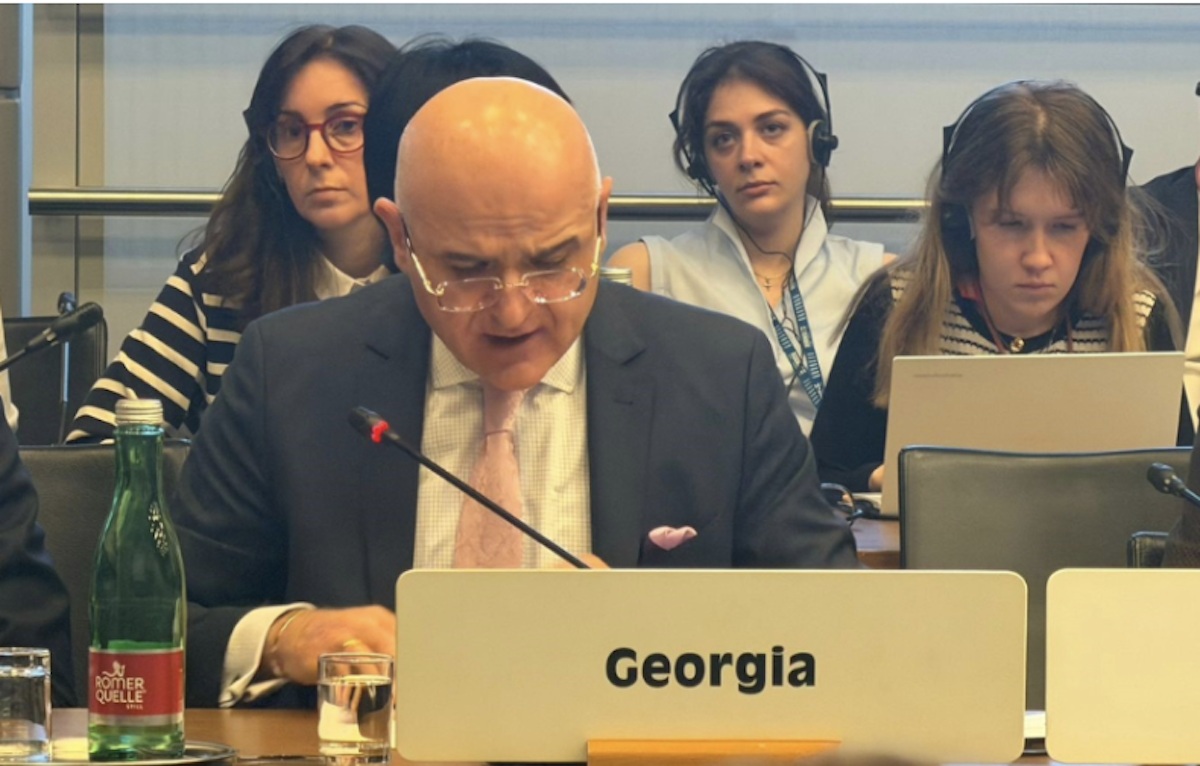
The Georgian authorities criticised the report. They said it does not reflect the full picture of the country’s political and legal reality. Georgia’s permanent representative to the OSCE, Alexander Maisuradze, said the report contains factual inaccuracies, selective interpretations and politically biased conclusions, which he argued undermine its credibility.
Nino Kalandadze said:
“The Moscow Mechanism is one of the strongest instruments that OSCE participating states can use against a country. Unlike resolutions, this mechanism is not purely declarative and can produce concrete results. States create such a commission when serious suspicions exist and require confirmation through an investigation. The commission receives a strong mandate that allows participating states to assess specific actions and make concrete decisions.
Participating states usually activate the Moscow Mechanism against countries where they assume from the outset that the state will not implement recommendations voluntarily. For this reason, the mechanism allows what can be described as universal enforcement. Participating states can begin inquiries and investigations independently. In simple terms, a specific country could decide that human rights violations in Georgia have reached such a level that it may seek the arrest of particular individuals.
The report uses terms such as ‘pattern’, which indicates a systemic nature of violence. It also uses the phrase ‘on the verge of torture’. In other words, the descriptive part of the report contains very strong language and leads to very serious recommendations. Implementing these recommendations no longer lies in the hands of Georgian Dream. That is precisely why the party has reacted so sharply.”

“The complaints of Georgian Dream do not interest anyone. Until now, they allowed themselves to say that European Parliament resolutions and similar statements ‘are not worth a penny’ and that they do not care what Europe says. But no matter how Georgian Dream tries to downplay the Moscow Mechanism report, its seriousness does not diminish.
International pressure on them is stronger than they imagine. Others heard their arguments, assessed them and ignored them because they do not correspond to the truth. The fact-finding mission concluded that Georgian Dream’s responses do not provide an adequate counterweight to the recommendations.
Georgian Dream has pursued a deliberate policy — both domestically and internationally — aimed at moving Georgia into the category of countries such as Russia, Belarus and Turkmenistan, which rejected the commission’s findings and criticised them. Georgian Dream’s own decisions and actions triggered the Moscow Mechanism. This was not accidental. They did this so that the West would give up on us, so that we would not receive EU candidate status or would see it suspended later, and so that our prospects for EU membership would be frozen.
The context changed when suspicions emerged that Georgia may be involved in transnational crimes in addition to human rights violations and mistreatment of the population. That is already a red line for the West, and OSCE participating states cannot ignore it.
These suspicions include the possible use of chemical agents to suppress protests, the illegal use of a corridor to bypass sanctions, drug trafficking and fraudulent call centres. Observers already speak about the comprehensive involvement of Georgian Dream in such schemes. Europe will not be able to ignore this.
Despite the war on the European continent and the conflict in the Middle East, the West has devoted attention to Georgia at a high level. This suggests that Europe considers Georgia part of its geostrategic policy. For that reason, Western actors will take additional steps. They may increase pressure on Georgian Dream to push the party towards negotiations and compromise. It is also possible that the West will not wait for Georgian Dream’s response and will take its own measures, because the facts described are too serious to overlook.”
“The demand to release political prisoners deserves special attention. The authors of the report treat the existence of political prisoners in the country as an established fact and express no doubt about it. The report calls for the ‘unconditional release’ of political prisoners. This wording sends a clear message. If Georgian Dream kept political prisoners as a bargaining tool, the report signals that such leverage will not work.
A country with EU candidate status should not hold political prisoners if its authorities want to sit at the negotiating table. By using the phrase ‘unconditional release’, the authors effectively say: ‘We will not accept any of your conditions until this requirement is fulfilled.’
The issue of releasing political prisoners had already been on the agenda. Georgian Dream treated it as an opportunity to delay and use the situation at a moment that suited them. The West has now responded that this issue cannot serve as a bargaining chip.”
OSCE Moscow Mechanism report on Georgia