Fake videos and leaked personal data: Georgian journalist Tornike Razmadze targeted in digital harassment campaign


Georgia’s first AI smear campaign against an activist
Tornike Razmadze, a journalist and critic of Georgian Dream, has become the target of a smear campaign. Between 21 and 23 November, anonymous social media accounts circulated AI-generated videos portraying him as a drug dealer.
His phone number was also published, accompanied by suggestions that people could use it to buy marijuana. The Georgian Young Lawyers’ Association (GYLA) described the incidents as a targeted harassment campaign.
Fact-checkers say this is one of the first cases in Georgian politics in which highly realistic AI-generated videos have been used in such a coordinated campaign against a government critic.
Tornike Razmadze is a journalist, blogger and civic activist. He regularly publishes videos criticising representatives of the Georgian Dream party, which attract large audiences. He also hosts two programmes on the Mismane YouTube channel.
What happened?
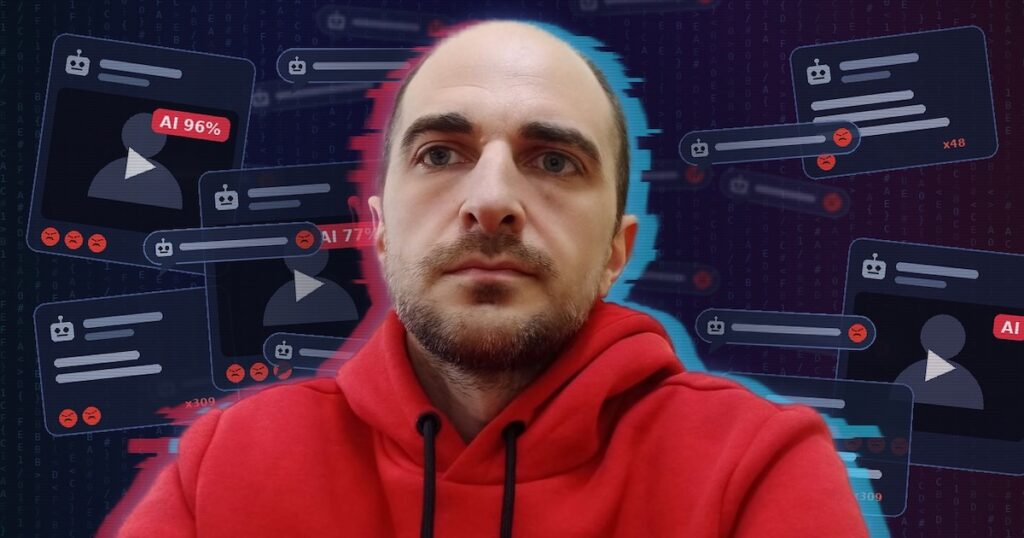
According to Myth Detector, on 21 November an anonymous Facebook page called Politikani published a video featuring Razmadze’s name. The page has previously been involved in smear campaigns against the opposition. The video shows a man who resembles Razmadze asking a drug dealer to hire him as a courier. It was accompanied by the caption: “Now it’s clear why he became friends with Akhobadze” (Giorgi Akhobadze is a Georgian doctor and activist who faced charges of illegally purchasing and possessing a particularly large quantity of drugs, but was later acquitted by a court – JAMnews).
On 22 November, a TikTok account called DaDash Pirveli published a video showing a man entering the stairwell of a residential building and bending down near the gas meters (apparently to leave a drug package – JAMnews). The video carried the caption: “Wasn’t it Tornike Razmadze who said, ‘It wasn’t me’?”
Georgian blogger says Interior Ministry wants to punish him for insulting Russian propagandists
On the same day, the Facebook page Ganulebuli Opozitsia published a photograph of Razmadze with a woman dressed in black. The post presented the woman as the mother of a young man who had died of a drug overdose. She blamed his death on “drug dealers like Razmadze”.
The Myth Detector fact-checking service concluded that the first two videos had been generated using artificial intelligence. According to InVID, there was a 96% probability that the video posted by Politikani was AI-generated. Sightengine put the probability for the TikTok video at 77%.
Fact-checkers note that both the anonymous pages and the TikTok account mentioned above had previously taken part in campaigns targeting government critics.
On 23 November, Razmadze’s phone number was also published on social media.
What does Razmadze say?
Razmadze has filed a complaint with the Interior Ministry. “The attacks against me have crossed the line into criminal activity. This is no longer just propaganda,” he said.
Speaking to TV Pirveli, he described the possible consequences of the digital harassment campaign: “This extremely dirty campaign could end with a physical attack on me or with someone planting something on me.”
Razmadze believes the authorities are behind the harassment. He says Dimitri Samkharadze, a Georgian Dream MP, discussed the possibility of physically attacking him in social media comments.
The activist links the campaign to his recent videos. In one, he recalls the case of Barbare Rapaliani (a 10-month-old girl whose tragic death in Georgia shortly before the 2012 parliamentary election became one of the country’s most high-profile and politicised unsolved cases in recent history – JAMnews). In another, he mocks comedians from pro-government television channels. Razmadze says both videos attracted widespread attention. He is now consulting lawyers.
How pro-government media covered the story
The campaign against Razmadze extended beyond social media to pro-government media outlets.
On 22 November, the Facebook page Pirveli Ambebi published footage of a residential building collapse in Batumi in 2021, presenting the incident as if it were happening at the time. The post claimed that hundreds of people were trapped under the rubble and that 30 had died.
The Interior Ministry denied the report, saying the post was intended to spread panic among the public.
Pro-government media outlets subsequently claimed that the Pirveli Ambebi page, which had circulated the false information, was allegedly linked to Tornike Razmadze. Their only evidence was that the page had previously published videos featuring him. None of the reports identified the people who ran the page.
Razmadze denies publishing the post and says he has no connection to the page. According to him, the page was created a long time ago and regularly published videos featuring other opposition figures. Razmadze has demanded that the Imedi, Rustavi 2 and POSTV television channels remove the false information and apologise.
What do human rights organisations say?
The Georgian Young Lawyers’ Association (GYLA) described the actions targeting Razmadze across various platforms as “a coordinated, targeted and systematic harassment campaign”.
The organisation says the materials published as part of the campaign amount to identity theft, as the videos reproduce Razmadze’s appearance and voice without his consent.
GYLA notes that the videos contain no elements of satire or parody, which “aggravates the negative impact on Tornike Razmadze’s rights – his rights to honour, privacy, identity and security”.
The organisation says the state has an obligation to assess such risks promptly, take protective measures and provide effective legal remedies for violations of these rights.
Reaction on social media
The story sparked widespread discussion on social media. Razmadze faced a wave of insults and accusations that echoed the narrative promoted by the fake videos. At the same time, many users expressed their support. Other bloggers and government critics voiced solidarity with Razmadze, warning the authorities that such campaigns could have dangerous consequences. YouTube bloggers and sports commentators also expressed their support.
Comedian Onise Okriashvili wrote on Facebook that this appeared to be the first case in Georgia in which someone had tried to discredit a person using hyper-realistic AI-generated videos rather than satirical ones.
Background: fined over remarks about Russian propagandists
A month before the campaign began, Razmadze was fined 3,000 lari. In September, the Interior Ministry opened administrative proceedings against him. The case concerned a Facebook comment containing obscene language directed at Kremlin propagandists Margarita Simonyan and Vladimir Solovyov. They had previously described Georgian King Erekle II as a ruler who “knelt down”. Razmadze’s video addressed those remarks.
A newly established Interior Ministry unit responsible for combating “hate speech” initiated the case. The Georgian Young Lawyers’ Association described it at the time as a precedent for censorship.
Razmadze says he expected a campaign against him after the authorities opened the case.
What happens next?
Razmadze is discussing further legal action with his lawyers. The Interior Ministry has yet to say whether it has launched an investigation following his complaint.
Georgia’s first AI smear campaign against an activist