Peaceful return of Abkhazia: opposition leader Nika Gvaramia's vision for Georgia's policy






Peaceful return of Abkhazia to Georgia
The Abkhaz conflict could be resolved not through war or discussions about the past, but through Georgia‘s European integration, economic development and shared security interests. Opposition politician Nika Gvaramia made the remarks in an interview with Formula television.
Gvaramia believes Georgia must overcome the trauma left by the war. At the same time, the country should become an attractive political and economic space for Abkhaz people.
He identifies EU membership, the development of the Anaklia port and a stronger Georgian role in the “Middle Corridor” as key elements of this strategy.
Gvaramia’s interview has already sparked public debate. Many viewers believe the politician moved beyond traditional rhetoric and proposed a rational and pragmatic approach to resolving the conflict, something rarely seen in Georgia’s political arena.
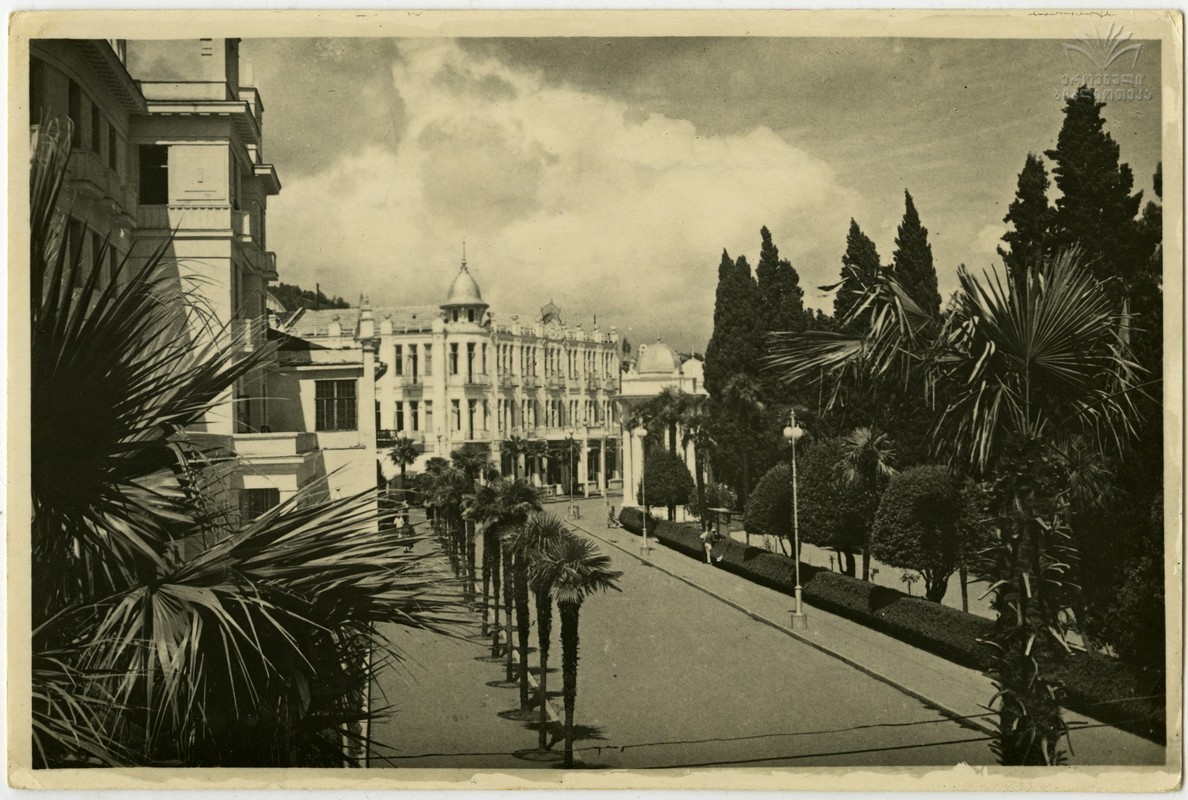
Personal memories of Sukhumi and Abkhazia’s strategic importance
Nika Gvaramia was 16 when he left Sukhumi. In an interview, he said he had lived in Tbilisi twice as long as he had lived in Sukhumi. Nevertheless, he still considers Sukhumi his home city.
For him, Abkhazia is both his homeland and a territory of particular strategic importance to Georgia. Gvaramia does not view the issue solely from the perspective of a displaced person.
He says Abkhazia’s geographical location, access to the Black Sea and economic potential distinguish this conflict from other conflicts in the post-Soviet space.
At the same time, he believes the 2008 war also demonstrated the strategic importance of the Tskhinvali region. The blockade of the country’s main transport route from that territory split Georgia in two and threatened links between the country’s eastern and western regions.
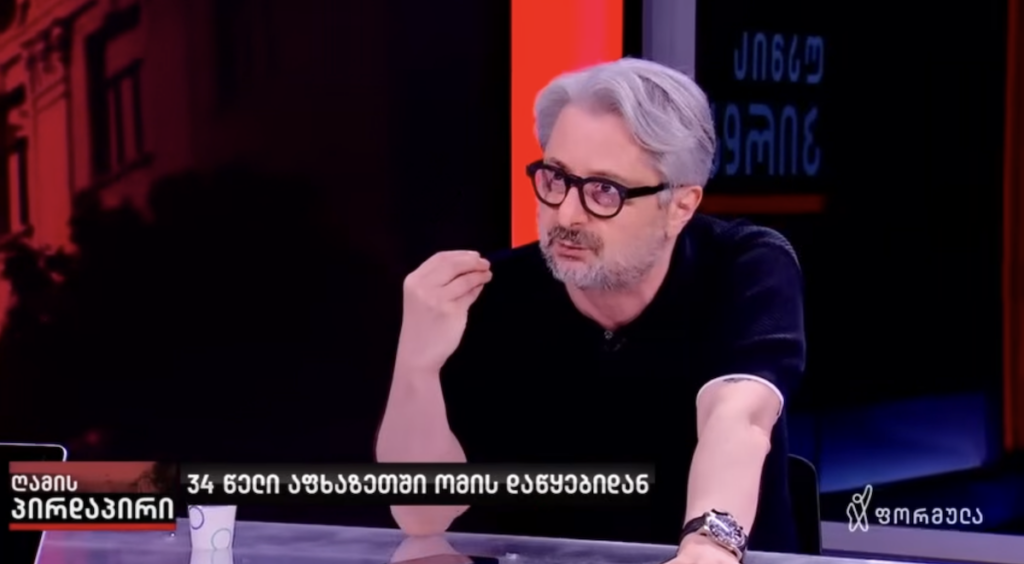
Gvaramia says that his experiences during the war and forced displacement made it difficult for him to look at the Abkhaz issue without emotion for a long time. He also recalls evidence of crimes committed in Abkhazia that he encountered while working at the prosecutor’s office.
However, he says that in recent years he has concluded that an approach based solely on trauma makes finding a solution impossible:
“Trauma is very important, it is part of historical memory… But traumatic memories are dangerous: they carry a threat, they act like a noose — they prevent us from moving forward and block development.”
Trauma, fear of war and government rhetoric
According to Gvaramia, Georgian Dream has turned the public trauma of war into a constant source of fear. As a result, the goal of restoring territorial integrity has given way to the attitude of “as long as there is no war”.
He said that for many years he himself approached the Abkhaz issue from a position of anger and intransigence. He considered dialogue with Abkhaz people impossible and saw the use of force as the solution. Later, he concluded that this approach was harmful to the country.
“Unfortunately, the actions of Georgian Dream have not led to the position that ‘this is my country, and I will fight to the end’. Instead, they have created the attitude: ‘I do not want war; there must be no war.'”
Gvaramia considers the desire to avoid war natural. People in Georgia have direct experience of the 2008 conflict: they watched the bombing of cities, the deaths of people and bombs falling on their country on live television.
However, he believes the problem arises when the government uses this experience as a tool of political control. Constant reminders of the threat of another war push people towards inaction instead of encouraging them to seek a solution to the problem.
In his view, Georgian society wants Abkhazia back, but not at the cost of war. Gvaramia believes politicians should take both sentiments into account at the same time.
“If we want to work with these people and consider ourselves politicians, we must understand that they also care about Abkhazia’s future, but they do not want war.”
According to Gvaramia, a military solution is unacceptable today not only because of public opinion. Georgia does not have the resources needed for such an approach, so statements about war that lack a realistic assessment of the country’s capabilities cannot form the basis of a responsible political plan.
He notes that the younger generation is gradually losing its emotional connection with Abkhazia and calls this one of the main challenges:
“Essentially, if we lose Abkhazia from our memory, that will also mean a real loss of the territory.”
In his view, over time, memories of the past alone will not be enough to preserve the idea of territorial integrity.
Pashinyan’s example and overcoming trauma
Gvaramia cites Armenian Prime Minister Nikol Pashinyan as an example of a leader who managed to overcome the burden of traumatic historical memory. In his view, Pashinyan tried to separate the state’s future from historical and territorial claims.
In this context, Gvaramia discusses Armenia’s changing approach to issues related to Mount Ararat and Karabakh.
He believes the aim of this policy was to free Armenia from Russian influence and create new economic opportunities for the country:
“Such changes take decades, but Pashinyan achieved them in a very short time. He removed the image of Ararat from the official seal and said that it is part of our history, but not part of our geography.
If we want problems with Turkey, then yes, let’s continue depicting Ararat, but then we will remain poor and dependent on Russia. If we do not want that, then let’s reach an agreement and remove Ararat from the seal, because it is not actually in our territory.
Then our relations with both Turkey and Azerbaijan will improve. We will have more money, gain the prospect of moving towards the European Union and no longer be tied to Russia.”
At the same time, Gvaramia stresses the legal difference between Abkhazia and Karabakh. He notes that the international community recognises Abkhazia as Georgian territory, while Karabakh was not recognised as part of Armenia.
But for him, the main issue is not the status of these territories, but the political influence of traumatic memories and the possibility of breaking free from their grip.
The European Union as a magnet for Abkhazia
According to Gvaramia, the first step towards rapprochement with Abkhaz people should rest on mutual needs rather than rhetoric about mutual love. He believes such appeals do not reflect the reality that has emerged since the war, and that the truth is that Abkhaz and Georgian people do not feel affection for each other today:
“We are lying when we say that we are brothers… We do not love each other now; we cannot love people who kill our neighbours. But we should think about the fact that, at this moment, we need each other from a pragmatic point of view.”
At the same time, Gvaramia stresses that Abkhaz people do not have warm feelings towards Russians either:
“Abkhaz people are not a nation that loves Russians, and they never have been. There is a perfectly rational reason for that. Russians consider them second-class people, while Georgians do not — and Abkhaz people feel this very clearly.”
Gvaramia envisions a Georgia that has joined the EU as an attractive country for Abkhaz people. Such a state would offer access to European passports, freedom of movement, a developed economy and institutional guarantees protecting minority rights.
In his view, EU involvement would also create financial opportunities for rebuilding Abkhazia. Security guarantees, meanwhile, would come not from a Russian military presence but from international and European institutions.
Under this model, Abkhaz people should not become second-class citizens of Georgia. They should have full political and civil rights:
“We are offering Abkhaz people a good life — and is there any Abkhaz person who would refuse a good life? But we are not offering it at the cost of turning them into second-class people. No, they must be full citizens of Georgia.”
Gvaramia believes Georgians and Abkhaz people will need several decades to become accustomed to each other again. At the initial stage, mutually beneficial economic cooperation could form the basis of their relations.
Anaklia and the Middle Corridor
A key element of Gvaramia’s strategy is the deep-water port of Anaklia. He sees Anaklia as a potential economic “magnet” for Abkhazia.
Under his plan, Georgia should become an important link in the Middle Corridor, connecting Central Asia with the Black Sea. The route would connect Europe with the markets and resources of Kazakhstan, Uzbekistan, Turkmenistan and other countries in the region.
Gvaramia places particular emphasis on rare earth metals and lithium. In his view, the importance of these resources is growing, while Central Asian countries need an alternative route to Western markets because existing routes depend on Russia, China or Iran.
“The main thing for me is EU membership and developing the Middle Corridor. I use this word deliberately — development. We need to develop this route.”
In his view, Georgia should build the Anaklia port with Western capital, while American, British and European organisations should take part in its management. In that case, the port would become more than just an economic asset and could provide an additional security guarantee for Georgia:
“Nothing receives stronger protection from the Western world than property: not international treaties, not security commitments, not the charters of any alliances. No, property enjoys the greatest protection in any Western society.”
Gvaramia also believes Anaklia needs a democratic system of governance to develop. A major international investor will not pursue a long-term project in conditions of corruption and a lack of transparency.
That is why, in his view, a Western investor sees the port’s construction, European integration, democratisation and restoration of territorial integrity as parts of a single strategy.
Gvaramia believes the port of Ochamchire could also become part of this economic space in the future. This would make cooperation with Georgia serve Abkhazia’s economic interests.
Limits of compromise and a governance model
In the interview, Gvaramia says resolving the conflict will require concessions from both sides. However, he does not propose a specific model for future political governance.
The discussion touched on the experiences of Lebanon, Bosnia, Northern Ireland and Cyprus. Some of these examples show that allocating government positions and powers along ethnic lines can make state institutions ineffective.
Gvaramia does not rule out an agreement covering Abkhazia’s special legal status, the distribution of political powers, the return of displaced people and property issues:
“Reconciliation is impossible without concessions.”
At the same time, he noted that Georgia is a state recognised under international law. Therefore, creating a new state “from scratch” should not become a necessary condition for resolving the conflict.
Gvaramia sees the European Union as the key foundation for a possible agreement. In his view, the EU accession process could provide security guarantees for Abkhaz people while preserving the principle of Georgia’s territorial integrity.
Enguri HPP: cryptocurrency mining and corruption allegations
In the final part of the interview, Gvaramia discussed electricity supplies and cryptocurrency mining in Abkhazia. He made serious corruption allegations against the government and Bidzina Ivanishvili personally.
According to Gvaramia, a significant share of the electricity generated by the Enguri HPP goes to Abkhazia free of charge. However, he says a substantial portion of this resource goes not to meet people’s needs but to power cryptocurrency mining farms:
“They supply them with twice as much electricity as they need, yet they still face shortages. It is astonishing. Why? Because this electricity goes to crypto farms — to the ability to make money literally out of thin air.”
He alleges that this scheme benefits groups operating in Abkhazia’s de facto authorities, Russian interests and people linked to the Georgian government.
He also criticised possible fuel supplies to Abkhazia from Georgian-controlled territory. According to Gvaramia, it remains unclear how such shipments are documented, who pays for them and where exactly the fuel goes.
In his assessment, there is a risk that the fuel could serve the needs of Russian military infrastructure in Abkhazia. Gvaramia also considers the issue in the context of Russia’s war against Ukraine.
Tamta Mikeladze’s assessment: an important vision and unanswered questions
Tamta Mikeladze, head of the Centre for Social Justice, described the interview as an expression of a rational and pragmatic political vision. She said Gvaramia had moved beyond established political rhetoric on Abkhazia and linked the issue of territorial integrity to the country’s development strategy.
Mikeladze particularly highlights his comments on overcoming traumatic memories, rejecting the false choice between war and capitulation, the European Union’s appeal and the possible role of the Anaklia port in strengthening security.
In her view, an important part of the interview is the challenge it sets for the opposition: alongside criticising the government, it should offer the country a comprehensive alternative project.
However, Mikeladze sees several problems with Gvaramia’s approach. The first is the possible overemphasis on economic interests.
She notes that in ethno-political conflicts, economic benefits do not always outweigh fears of losing one’s identity, nationalist narratives and the idea of independence.
Therefore, Tbilisi should offer solutions on protecting Abkhaz identity, language and political autonomy. A promise of prosperity alone will not be enough.
The second issue is the Russian factor. According to Mikeladze, Gvaramia’s model relies heavily on a weakening of Russia.
It remains unclear what would happen if Moscow maintained its influence and military bases in the region. Under such circumstances, economic appeal cannot replace alternative security guarantees.
The third issue concerns efforts to overcome trauma. Mikeladze notes that Pashinyan’s approach has caused serious divisions within Armenia.
Some sections of society see his policies not as overcoming trauma but as a national defeat. Such changes therefore require long-term democratic, social and cultural work with communities affected by the conflict.
The fourth issue concerns the model for sharing power. According to Mikeladze, this aspect has often undermined previous peacebuilding efforts. The political status of Abkhazia, its representation and the distribution of powers are therefore far from secondary details.
Despite these questions, Mikeladze considers the interview an important basis for public debate. She believes other politicians should also offer democratic, future-oriented alternatives rather than build their positions around the traumas and confrontation of the past.
She also calls on the media to exercise caution. According to Mikeladze, if Georgian Dream uses territorial integrity to justify political or economic interests, the opposition should provide a well-grounded response.
Mikeladze’s main message is that the debate on Abkhazia should no longer focus solely on memories of war, mutual accusations and general calls for reconciliation.
Public policy should answer difficult questions: how will Abkhaz identity be protected, who will guarantee security, how will power be shared, and under what conditions can a common political space be created?
Peaceful return of Abkhazia to Georgia