'There are issues that need to be discussed' - Armenia’s parliament speaker warns Lavrov






Armenia’s parliament speaker meets Lavrov
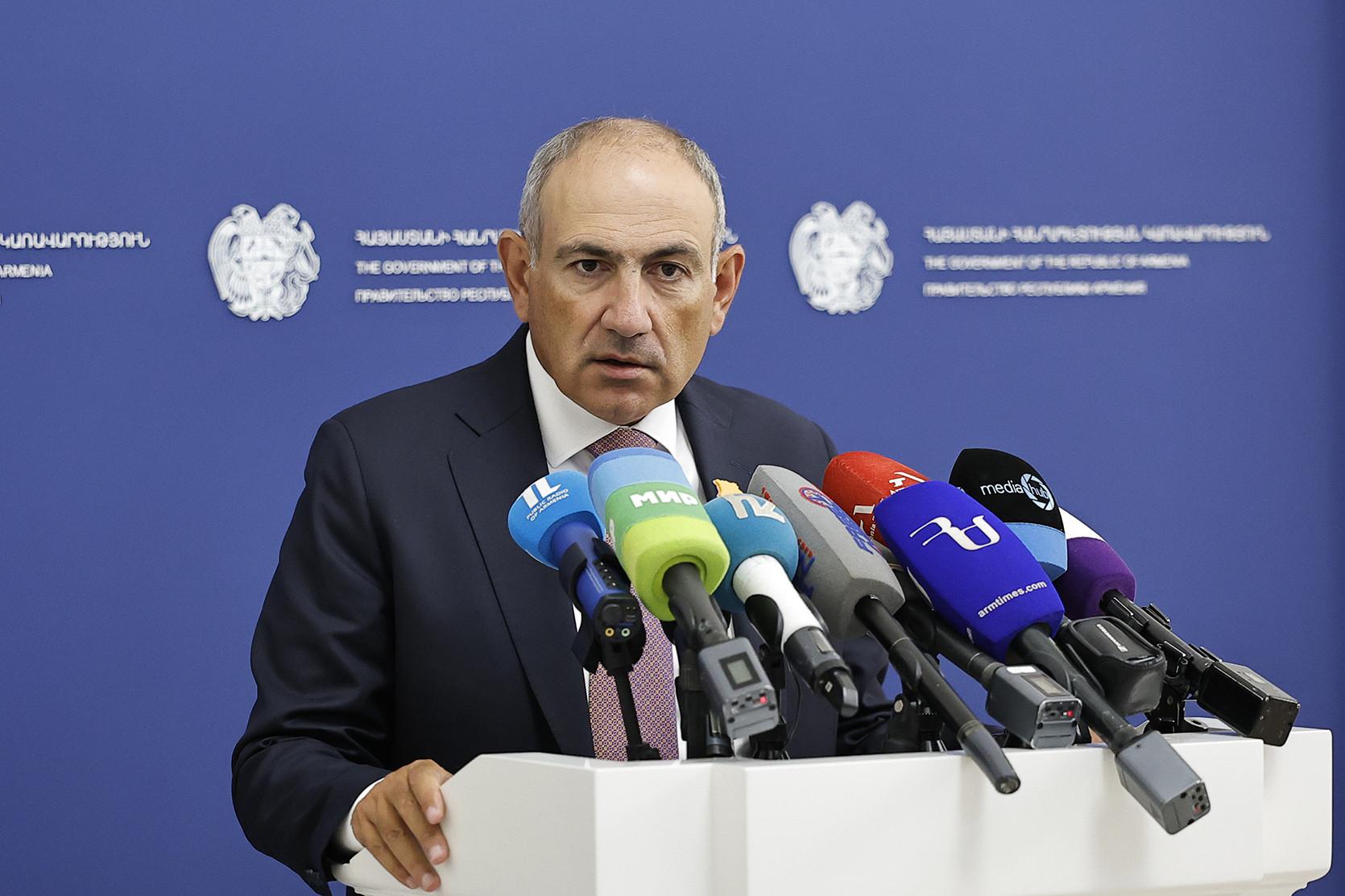
Armenia’s parliament speaker Alen Simonyan is on an official visit to Russia upon the invitation from his counterpart, Federation Council chair Valentina Matviyenko.
However, Simonyan’s first meeting was with Russian Foreign Minister Sergei Lavrov.
In the part of the talks open to journalists, Lavrov said Armenia’s leadership had expressed interest in maintaining the current level of cooperation with Russia, adding that “not all non-regional countries are happy about this”. He also said Russia did not oppose its allies developing relations with other partners, but claimed the European Union was putting them “before a choice — either with us or with them”.
Responding, the speaker of Armenia’s National Assembly said: “I want to assure you that there is no and will be no perception in Armenia of ‘with us or against us’. We believe this is wrong.”
Lavrov also spoke about upcoming elections in Armenia, calling it strange that signals were coming from the West about interference in electoral processes “with a clear hint at the Russian Federation”.
He commented as well on Yerevan’s appeal to the EU to prevent such interference. “I have no doubt that responsible politicians in Yerevan fully understand that these moves are made with openly provocative aims,” the Russian diplomat said, while stressing that Russia respects Armenia’s sovereign choice.
“We are equally interested in Armenia being sovereign, strong and self-sufficient, and able to choose its own foreign orientation in discussions about what matters most and what is most beneficial for Armenia — continued integration within the Eurasian Economic Union or a transition to the norms and standards of the European Union,” Lavrov said.
The two sides then moved to closed-door talks.
- Opinion: ‘Everything must be done to ensure Russian Railways leaves Armenia’
- ‘Deepening ties with US and EU does not mean expelling Russia’ — Armenian foreign minister
- Opinion: ‘Armenia will restore rail links with Azerbaijan and Turkey – with or without Russia’
Lavrov: “It is strange to hear about mythical ‘attacks from the north’ against Armenia”
Russia’s foreign minister Sergei Lavrov said it was strange for Moscow to hear claims about “mythical attacks from the north” against Armenia.
Lavrov recalled that Russia remains Armenia’s main trading partner and approaches this role responsibly. Speaking about Armenia’s membership of the Eurasian Economic Union, he stressed that it is incompatible with accession to the European Union. He emphasised that Russia’s position “is not driven by any ideological motives, but stems from realities”, while adding that Moscow would “fully respect” Armenia’s choice.
Lavrov said he believed the trilateral agreements reached by the leaders of Armenia, Russia and Azerbaijan in 2020–2022 remain relevant for addressing economic, transport and logistics issues in the South Caucasus, and that Moscow is ready to take part in their implementation.
The Russian minister appeared to be referring primarily to the 9 November statement that marked the end of the 44-day war in 2020. Under that document, Russia was to oversee a route running through Armenian territory to link Azerbaijan with Nakhchivan.
However, under the Washington agreements on 8 August 2025, the route was designated part of the Armenian–US TRIPP project. Moscow has repeatedly said it is ready to take part. Yerevan says third countries can only be involved with the consent of the two main participants.
Armenia’s parliament speaker Alen Simonyan has called Russia’s participation in TRIPP “absurd”, saying it would ensure the project never starts. Simonyan is one of the most outspoken figures in Pashinyan’s team and a frequent critic of Russia’s stance on Armenia.
Simonyan: “Armenia is interested in maintaining ties with Russia”
Armenia’s parliament speaker Alen Simonyan said he did not want Russia to think Armenia was acting against Moscow.
“I do not want Russia to form the impression that Armenia is trying to do something against Russia, a friendly allied state, even though, of course, there are issues that need to be discussed,” Simonyan said.
He stressed that Yerevan is interested in maintaining ties with Moscow, including within the Eurasian Economic Union(EAEU).
“As for the EAEU and the customs union, we do not believe we should leave it. We think we can together find a solution that would benefit both sides,” he added.
Simonyan also responded to remarks by Russia’s foreign minister Sergei Lavrov regarding the Collective Security Treaty Organization (CSTO). He voiced dissatisfaction at accusations that Armenia’s authorities were speaking of an “existential threat” from the CSTO.
Simonyan reaffirmed that Armenia has frozen its membership, citing a lack of answers from the organisation.
Yerevan requested assistance from the CSTO after Azerbaijani armed forces advanced several kilometres into Armenia’s sovereign territory in 2021–2022. In 2021, the CSTO described the situation on the Armenia–Azerbaijan border as a “border incident” and refused to respond. In September 2022, the bloc proposed deploying an observer mission to Armenia’s border instead of providing military assistance. Armenia rejected the proposal. The CSTO also said the Armenia–Azerbaijan border was unclear, as it had not been formally delimited.
“If we say there is no border between Armenia and Azerbaijan, then there is no CSTO. Because the CSTO has an area of responsibility defined by borders. If there is no border, there is no area of responsibility. And if there is no area of responsibility, there is no organisation,” Nikol Pashinyan said. Subsequently, in February 2024, Armenia announced that it was freezing its membership in the Collective Security Treaty Organization.
Alen Simonyan also expressed concern over what he described as negative and unacceptable rhetoric towards Armenia in Russia’s public space. He said he had raised the issue in discussions with Russia’s ambassador to Armenia.
“Armenian society reacts very negatively to the statements coming from Moscow. It reacts that way because Moscow matters — its opinion matters. The understanding that Moscow is an ally has existed and still exists. That is why hearing such remarks is so painful.”
Simonyan pledged to raise all issues important to Armenia ahead of Moscow visit
Ahead of his trip to Moscow, Simonyan said he intended to discuss all issues of importance to Armenia.
Speaking in an interview with an Armenian television channel several days before the visit, Simonyan detailed his upcoming visit.
“When Ms Matviyenko was here, a forum was held and a number of agreements were signed between Russian regions and Armenian provinces. The issue of their ratification remains. We will discuss these matters and Armenian–Russian relations,” he said.
For some time, Armenia’s authorities have been speaking about hybrid attacks ahead of parliamentary elections scheduled for June 2026. Simonyan reiterated that the attacks were coming from Russia and that he planned to raise the issue with Russian partners.
At the same time, the parliament speaker said references to hybrid attacks were not aimed at those he was due to meet in Russia.
“Hybrid attacks are not carried out only by states. There are individuals who have penetrated politics. There is a well-known Russian saying: ‘The Kremlin has many towers.’ Among them are also Armenian figures living in Russia who have their own interests. There are different vectors of attacks,” he said.
Simonyan added there was no need to look for a conflict between Pashinyan and Vadimir Putin, or between himself and Matviyenko, stressing that no such problem exists.

Expert opinion
Political analyst Ruben Mehrabyan believes:
“Rarely does it happen that a parliament speaker, travelling to another country, meets that country’s foreign minister — especially in Armenian–Russian relations. These are, so to speak, non-intersecting trajectories. But this time it happened.
It is unclear what political objectives Alen Simonyan intends to pursue. Has he gone to try to bring the Russian threat under control, or to reach some kind of agreement? Time will tell. Although it is highly doubtful that any agreement can actually be reached.
Simonyan is meeting a figure whose sore point exists only because we have reached agreements with our partners in Europe and the United States — to our benefit and to the benefit of our region.
As this is a region neighbouring Russia, this would also objectively be in Russia’s interests, if one thinks rationally and if these sore points were not so painfully sensitive without cause. But they will hurt regardless of our wishes, because these agreements turn Russia into a player with the status of ‘one among many’ — and even that only if Russia acts pragmatically. Otherwise, it may not even retain that status if it fails to show pragmatism and continues on its current course.”